


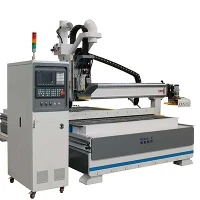
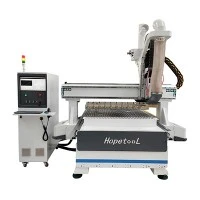


Multi Head CNC Router
Why choose us
High Productivity
Our factory covers an area of 8,000 square meters and is equipped with 5-axis CNC center machine tools and quality inspection equipment, and can produce 120 different machines a month.
Quality Assurance
Our production process complies with strict ISO system standards. All products undergo 100% quality inspection, obtain CE and various patent certificate certifications, and can provide corresponding quality inspection reports.
Highly Professional
With rich professional knowledge, we provide technical guidance and usage training services for laser machines to a large number of customers, helping them automate their production lines and improve productivity.
Fast Shipping
We ensure the production time of the laser machine is about 10-20 days, and cooperate with professional sea, air and express logistics companies to provide fast shipping and expedited shipping services.
The multi head CNC router support spindle integrated control for multi-head from 2 to 8pcs, can delivery command to spindles to work in tandem, also can work similarly as CNC router with an auto tool changer. When the first spindle complete its work, the second spindle can go on its own work automatically. This kind of multi axis cnc router can be determined based on machined material, and 3d engraving can also be achieved by equipping ordinary engraving machine with rotating axis.


Benefits of Multi-Head CNC Router
High Precision and Accuracy while Cutting
CNC (Computer Numerical Control) systems are designed to deliver precise and consistent results. Every cut, drill, or shape created by a CNC machine is highly accurate, which means you will get exactly the same result every time. This is particularly important if you are making parts that need to fit together perfectly or require tight tolerances.
Improved Efficiency and Productivity
CNC machines work faster and more efficiently than manual methods. They can operate continuously, 24/7, without needing breaks. This means you can produce more parts in less time, increasing your overall productivity and allowing you to meet customer demands quickly.
Reduced Waste and Lower Costs
With a CNC system, the precision of the cuts and operations reduces the amount of wasted material. This means you can save money on materials and reduce production costs. Over time, this leads to significant cost savings, making your manufacturing process more economical.
Ease of Use and Automation
Once programmed, a CNC machine can run automatically without constant supervision. This makes it easier for operators, as they don’t need to manually control the machine at every step. It also allows for multitasking, where one operator can oversee multiple machines, further increasing efficiency.
Versatility and Flexibility
CNC machines can be used for a wide range of applications, from cutting metal and plastic to engraving and milling. They can handle complex designs and different materials with ease, allowing you to take on a variety of projects. You can quickly switch from one job to another, adapting to customer needs or market changes.
Improved Safety
With CNC machines, the operator is not required to be in direct contact with cutting tools or moving parts. This reduces the risk of accidents and injuries, making the work environment safer. The machine also has built-in safety features that can stop operations if there is a problem, which further protects the operator and the equipment.
4.Difference Between Multi-Head CNC Machines and Other CNC Machines
The main difference between a multi-head CNC machine and a three-axis CNC machine is that the former contains multiple machining spindles. Since these spindles can perform automatic tool changes, a multi-head CNC machine functions similarly to a simple and inexpensive ATC (Automatic Tool Change) CNC machine. Different spindles can be selected and switched manually for engraving, and multiple spindles can work simultaneously on an engraving machine. Multi-head CNC machines have become increasingly popular in the production of panel furniture. In this section, we will compare and contrast three-axis CNC wood machines and multi-process engraving machines in terms of processing materials, operating techniques, processing effects, application scope, and target customers.
Total Number of Spindles: A three-axis CNC wood machine has only one main spindle (or one rotating shaft), whereas a multi-head CNC machine has more than two spindles (with four-head machines being common).
Material Preparation: Materials that can be processed by standard engraving machines can also be handled by a multi-head CNC machine. It can work with PVC boards, MDF, imitation marble, aluminum sheets, and other materials. The range of processable materials is broader compared to a three-axis CNC wood machine.
Operation Complexity: The operating principles of these two types of CNC routers are similar. They are computer-controlled and straightforward to learn and use. The complexity arises with the multi-head engraving machine due to the need for replacing the work spindles. However, skilled technicians provide free operational training to address this.
Processing Effects: Both multi-head CNC machines and three-axis CNC wood machines can perform plane engraving and etch beautiful patterns. However, multi-head CNC machines can also achieve more complex and precise processing tasks, such as relief carving and 3D engraving.
Application Scope: Multi-process engraving machines can handle a wide range of tasks, from carving intricate artwork to producing conventional furniture such as doors and windows, cabinets, screens, and mold carvings.
Targeted Customer Groups: If you only need to perform simple plane engraving and do not require high precision, a standard woodworking engraving machine will suffice. For batch processing, complex patterns, and high precision requirements, a multi-process engraving machine is a better choice. It offers similar functionality to an ATC CNC machine at a lower cost. If budget constraints make an ATC CNC machine impractical, the multi-process engraving machine is a valuable alternative.
Consistency in Quality: With manual machining, there can be slight variations from one part to another. CNC machines eliminate this problem by providing consistent quality across all parts. This is crucial for maintaining high standards and satisfying your customers with reliable products every time.
Reduced Dependence on Skilled Labor: Traditional manual machining requires highly skilled operators to achieve precise results. With CNC systems, much of the skill is in the programming, not the physical operation. This reduces the need for specialized labor, making it easier to train employees and find suitable operators.
Scalability for Business Growth: As your business grows, CNC systems can easily scale with your production needs. You can increase the number of machines or upgrade to more advanced models without changing your entire process. This makes it easier to expand your operations and meet increasing demand.
Main Types and Application Scope of CNC Routers
With the rapid development of CNC router machines, they can be classified into woodworking machines and stone machines based on their application industries. Below are details about the application and classification of these machines to help you choose the most suitable one.
Wood CNC Router Machine
CNC router machines are widely used in various industries and are commonly employed for carving, cutting, milling, and other processing methods for wooden furniture such as cabinets, wardrobes, tables, and chairs. If your workshop specializes in the production of panel furniture, adding an automatic loading and unloading function is recommended. This feature can significantly reduce labor costs and improve processing efficiency by up to 200%. Additionally, for batch cutting, incorporating automatic steering data can achieve fast cutting and increase cutting thickness. For engraving the same pattern on multiple plates, choosing a multi-head engraving machine is advisable. This allows for mass production and greatly enhances processing efficiency.
SIGN CNC offers multiple functions and customization options. If you are involved in the woodworking industry, simply provide the type, size, and finished product requirements of the processed materials, and we will supply you with the most suitable machine.
Stone CNC Router Machine
With the advancement and application of numerical control technology, manual engraving is gradually being replaced by CNC engraving. Stone engraving machines not only save labor costs but also offer higher engraving efficiency. They use high-power spindle motors specifically designed for stone carving, which provide strong cutting force. The machines feature high-precision rack and pinion transmission with helical racks, ensuring greater precision, faster speed, and more stable operation. Equipped with a manual oiling system, these machines ensure comprehensive lubrication of transmission parts, reducing wear and tear and maintaining machining accuracy and machine stability. Worktables with customizable processing areas and feeding heights can be tailored to customer needs, and machines can be upgraded to include multiple heads to further enhance work efficiency.
The working principle of a multi-head CNC router involves a series of automated processes that enable the machine to efficiently cut, carve, and shape materials. This technology enhances productivity by eliminating the need for manual tool changes during the machining process.
The CNC router operates based on a computer-aided design (CAD) file that provides precise instructions for the machine’s movements. The process typically involves the following steps:
Design and Programming: A 3D model or design is created using CAD or other design software. Toolpaths are generated to define the router’s movements and cutting paths.
Loading Material: The material is secured onto the machine’s worktable. Proper alignment and fixation are crucial to prevent errors during the cutting process.
Tool Selection: The ATC (Automatic Tool Changer) system holds a variety of cutting tools in a tool magazine. The appropriate tool is selected based on the programmed toolpath and the desired outcome.


Tool Change: When the machine reaches a point where a different tool is required, the ATC system automatically selects the needed tool from the tool magazine and places it into the spindle.
Machining Process: The CNC router’s spindle rotates the cutting tool at high speeds. The machine follows the programmed toolpath, accurately cutting and shaping the material according to the design.
Automatic Tool Change: As the machining process progresses and different tools are needed, the ATC system repeats the tool change process. This eliminates the need for manual intervention and minimizes downtime between tool changes.
Dust Collection: Woodworking CNC routers often include dust collection systems to keep the work environment clean and maintain visibility of the cutting area.
Finishing and Quality Control: Once machining is complete, the finished product is inspected for quality. Additional finishing steps, such as sanding or varnishing, may be required depending on the desired final outcome.
Unloading: After completing all required machining tasks, the finished product is removed from the worktable, and the machine is ready for the next project.
When Choosing Between A 4-Axis And A 5-Axis Cnc Router, Consider The Following Aspects
Future Development
Consider your company’s future development needs. If you anticipate expanding into more complex machining areas, investing in a 5-axis CNC router may be more suitable.
Application Areas
Consider your application areas, such as furniture manufacturing, mold making, architectural models, and advertising production. Some applications may be better suited to a 4-axis machine, while others may benefit from the advanced capabilities of a 5-axis CNC router.
Investment Budget
Compare the prices of 4-axis and 5-axis CNC routers to see if your budget can accommodate the investment. 5-axis CNC routers are typically more expensive but offer enhanced processing capabilities and efficiency.
Operation and Maintenance
Consider the skill level and experience of the operator. Operating and maintaining a 5-axis CNC router may require higher expertise. If your operators are inexperienced, additional training or technical support might be necessary. Also, consider the equipment's reliability, maintenance costs, and after-sales service.
Equipment Compatibility
If you already own other CNC equipment, consider the compatibility of the new machine with your existing setup. For instance, you might want the new equipment to use the same control system or software to streamline operation and data transfer.
Processing Needs
First, analyze your processing needs, including the type of material, accuracy, speed, shape, and size. Compare the performance characteristics of 4-axis and 5-axis CNC routers to determine which best meets your requirements. Generally, 5-axis CNC routers excel in processing complex shapes and achieving high precision.
There is a significant risk of fire caused by excessive friction with improper clearing of chips or dull cutting surfaces on a CNC machine end.
Cutting conductive materials like metals and carbon fiber creates both dust and coarse particles that are capable of settling inside of electronic equipment and causing electrical shorts, electrical fires, and battery explosions. Always use proper ventilation, clean up particles, and have a working fire extinguisher at hand.
Inhaling dust from some materials can cause respiratory diseases, poisoning, and cancer. Consult and post the MSDS (Material Safety Data Sheet) for the materials you are cutting by consulting your OSHA representative or conducting a search for the MSDS online.
Risk of explosion occurs when high-surface-area particles (dust) produced by a CNC machine floating in the air are exposed to ignition sources like electrical motors or hot cutting ends. Ensure that all dust is vacuumed away while cutting and that the area is well-ventilated.
Our Factory
Jinan Hopetool CNC Equipment Co., Ltd. is a professional company specializing in developing and manufacturing different kind laser machine, include: CNC router, laser machine, digital cutting machine. Our company builed on 2008, after 14 years hard work, our machines have been exported to more than 80 countries, and we have established regular business relationships with many distributors from many countries.


Certificate
